
P.A.B. Romania: web & corporate print design for a multinational construction group

Summary
Brief
P.A.B. Romania is a privately held multinational construction group founded in 1993, headquartered in Arad, Romania, with subsidiaries in Germany, the UK, and Serbia. With an aggregate turnover exceeding EUR 83 million and over 200 completed projects in Romania alone, the company had no functional digital presence — an outdated, content-sparse website, and no centralised archive of its project history or capabilities. The brief: a full corporate web and print design overhaul.
My contribution
I led the complete digital and print overhaul of P.A.B. Romania’s corporate presence. Key contributions included:
- Information research: Sourced and catalogued the company’s project history from scratch across departments.
- Web redesign: New information architecture, visual system, and multilingual content structure.
- Copywriting & translation: All content written and translated across Romanian, English, Italian, and German.
- Print design: Two corporate brochures designed as a matched set in Adobe Illustrator and InDesign.
- Technical verification: Close collaboration with engineering teams to ensure precision across all published specifications.
The result was P.A.B. Romania’s first comprehensive, multilingual corporate presence in both digital and print.
Year
2020
Client
P.A.B.
Arad, Romania
Services
- Web redesign
- Information architecture
- Multilingual content strategy
- Copywriting & translation
- Print design (Adobe suite)
THE PROCESS - STEP 1
Information research & verification
P.A.B. Romania had no centralised archive of any kind. Over 200 completed projects in Romania alone existed only in fragments — photographs on personal devices, files on old office computers, and the recollections of long-serving and near-retired staff. The research phase ran in parallel with all other workstreams and was a prerequisite for both the website and the print materials.
PROJECT ARCHIVE
Direct interviews were conducted with engineers, project managers, and site supervisors to reconstruct project histories and recover photographic and documentary material. For older projects this required tracking down staff who had been on site years or decades earlier. The process produced the company’s first structured project portfolio.
CERTIFICATION MANAGEMENT
P.A.B. Romania holds a range of European-recognised certifications — ISO 9001:2015, ISO 14001:2015, ISO 45001:2018, EN 1090-1, EN 1090-2, ISO 3834, and a NATO NCAGE code. Each was verified against official documentation before publication. In a B2B procurement context, these are filtering criteria — an error or omission directly affects whether the company appears in supplier searches.
CLIENT LIST & REFERENCES
Reference projects included Porsche, Aston Martin, Bauhaus, LIDL, and Selgros across multiple European countries. Every client name, project description, and location was confirmed with the relevant internal contacts. All technical specifications were verified directly with the engineering department before going live.
With the information base in place, the work on both deliverables (website and brochure) could begin in parallel.
THE PROCESS - STEP 2
Corporate web design
With the research phase complete and a working content base established, the redesign could begin in earnest. The existing WordPress installation was retained as the technical foundation, but everything built on top of it was replaced — structure, visual system, content, and language architecture.
Information architecture
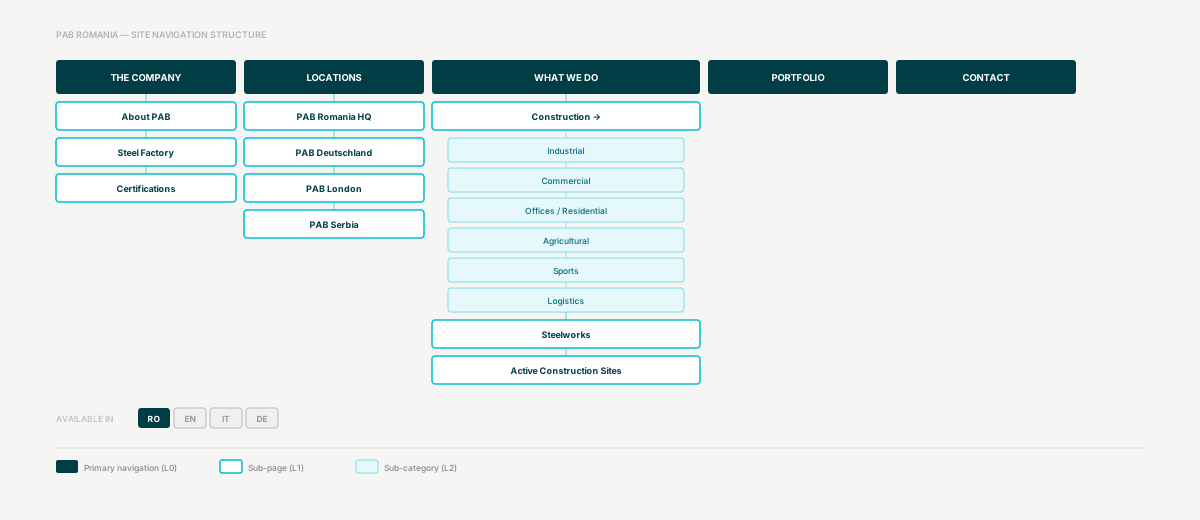
The old site’s navigation reflected how the company was organised internally, which is rarely how an external visitor thinks. The new structure was built around the five questions a potential client or partner is most likely to arrive with: who are you, where do you operate, what do you build, what have you already built, and how do I reach you. Each of these became a primary menu item — company, locations, services, portfolio, and contact — with services expanded into a mega menu covering all construction specialisations, the metalwork division, and a dedicated section for active construction sites.


Visual system
The teal that defines PAB Romania’s physical identity — present in the building’s cladding, signage, and interior finishes — had never been consistently applied to the company’s digital presence. The redesign corrected this, using the colour as the primary accent throughout, combined with clean typography and full-width photography drawn from the project archive. The goal was coherence, not reinvention: a visitor arriving at the site should immediately recognise the same organisation they might encounter in person.
Multilingual structure
PAB Romania operates construction projects across four European countries and markets its services to clients in Romania, Germany, the UK, and Italy. A single-language site was not adequate for this audience. The site was built in four languages — Romanian, English, Italian, and German — using Polylang, with hreflang tags implemented to ensure correct search engine targeting by market. Romanian, English, and Italian content was written and translated directly as part of this project; the German version was handled in collaboration with the PAB Deutschland team.
Content & copywriting
All page content was written from scratch across four languages — company and group history, subsidiary profiles, service and construction type descriptions, and individual project entries from the archive. Given the presidential approval requirement for every piece of published content, the writing process involved multiple rounds of review and revision, requiring close alignment between what was strategically optimal and what would be sanctioned at each stage.
THE PROCESS - STEP 3
Corporate print design
The print design brief originally called for a single brochure. During the research phase, however, it became clear that the steel factory represented a sufficiently distinct business unit — with its own client base, technical specifications, and sales context — to warrant a dedicated document. A procurement officer evaluating a metalwork supplier has different information needs from one evaluating a general contractor, and a single brochure serving both audiences would serve neither particularly well.
The existing brochure offered no viable foundation for iteration — its cover layout was an unstructured photo collage with no underlying grid, no typographic system, and no connection to the company’s physical identity beyond the logo. Rather than adapt it, the decision was made to start from scratch. The new design was built around a clean grid, a restricted type palette, and the teal that defines PAB Romania’s architecture — establishing a visual language that could carry across both documents and hold up across future editions.

BEFORE

AFTER
The result was two documents designed as a matched set: the Company Profile, covering the full group, construction specialisations, project references, financials, and certifications; and the Steel Factory brochure, focused on the production facility, machinery, technical capabilities, and metalwork output. Both were designed in Adobe Illustrator and InDesign, applying the same visual language as the website — teal accent, clean typography, full-width photography — to ensure consistency across every touchpoint a client or partner might encounter.
Visual design
Tools
- Adobe InDesign
- Adobe Photoshop
- Adobe Illustrator
Editorial choices
The two brochures share a common grid, type system, and cover architecture: a deliberate decision to establish them as a coherent document family despite their different content scopes. The layout was designed with reusability as a primary constraint: rather than a one-off composition, the structure needed to function as a repeatable template, accommodating annual updates without layout intervention. This drove two specific design decisions — reserved fields for the edition year and the language variant, both treated as fixed positional elements within the grid. Both documents were produced in Romanian and English.
Visual design
TOOLS
- Adobe InDesign
- Adobe Photoshop
- Adobe Illustrator
EDITORIAL CHOICES
The two brochures share a common grid, type system, and cover architecture: a deliberate decision to establish them as a coherent document family despite their different content scopes. The layout was designed with reusability as a primary constraint: rather than a one-off composition, the structure needed to function as a repeatable template, accommodating annual updates without layout intervention. This drove two specific design decisions — reserved fields for the edition year and the language variant, both treated as fixed positional elements within the grid. Both documents were produced in Romanian and English.
Visual design
TOOLS
- Adobe InDesign
- Adobe Photoshop
- Adobe Illustrator
EDITORIAL CHOICES
The two brochures share a common grid, type system, and cover architecture: a deliberate decision to establish them as a coherent document family despite their different content scopes. The layout was designed with reusability as a primary constraint: rather than a one-off composition, the structure needed to function as a repeatable template, accommodating annual updates without layout intervention. This drove two specific design decisions — reserved fields for the edition year and the language variant, both treated as fixed positional elements within the grid. Both documents were produced in Romanian and English.
Visual design
TOOLS
- Adobe InDesign
- Adobe Photoshop
- Adobe Illustrator
EDITORIAL CHOICES
The two brochures share a common grid, type system, and cover architecture: a deliberate decision to establish them as a coherent document family despite their different content scopes. The layout was designed with reusability as a primary constraint: rather than a one-off composition, the structure needed to function as a repeatable template, accommodating annual updates without layout intervention. This drove two specific design decisions — reserved fields for the edition year and the language variant, both treated as fixed positional elements within the grid. Both documents were produced in Romanian and English.
COMPANY PROFILE
30 PAGES
A 30-page document covering the full P.A.B. Group — the Romanian parent company and its three European subsidiaries — alongside the range of construction specialisations, selected project references, financial data, expansion plans, and the full certifications list. Designed as a leave-behind for business development conversations across all four European markets, produced in English.
STEEL FACTORY
35 PAGES
At 35 pages excluding certificates, the more technically detailed of the two documents. It covers the production facility in depth — assembly lines, overhead crane capacity, CNC processing equipment, laser cutting specifications, sandblasting and painting infrastructure. The level of technical precision required here was significant: specifications such as cutting tolerances, material thicknesses, and machine capabilities were verified directly with the engineering team before going to print.
The two brochures
Both documents are available to browse in full.


Outcomes
For the first time, P.A.B. Romania’s project history — spanning over 200 completed constructions — was researched, structured, and presented in a coherent portfolio.